
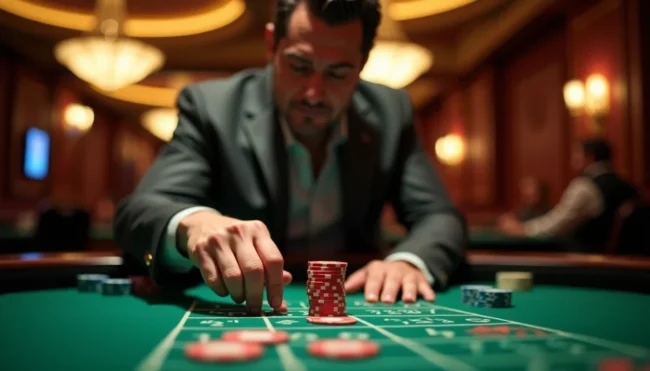
The first time you see a man push a million dollars across felt with two fingers, the sound of the casino changes. The main floor roars with bells and synthetic cheers, but in the room behind the frosted glass, the only noise is the whisper of plastic chips and the dealer’s quiet call. You do not stumble into these spaces. You are collected from a private elevator, passed through a door that does not show a handle, and seated at a table where the minimum bet would cover two months of rent in most American cities.
What the Floor Hides
Walk any major Strip property at midnight and the math is visible in the lighting. The main floor glows with $5 blackjack and penny slots, designed to keep thousands of bodies circulating, drinking, losing in twenty-dollar increments. The house edge on a 6:5 blackjack table with continuous shuffle is a slow bleed, sustainable, industrial. Around the corner from the high-limit slots, past the cashier cage with its velvet ropes, sits another geography entirely.
At Wynn’s Salon Privé or the Villas at Bellagio, the baccarat minimum opens at $500 and climbs fast. For the right player, the kind who arrives with a wire transfer and a reputation, a single hand can run $300,000 to $500,000. The upper bound is not really a bound at all. Casino management will negotiate into seven figures for a shoe because a player capable of losing that much in an evening represents theoretical win that dwarfs the annual revenue of most small businesses. The Bellagio once accepted a baccarat wager north of $1 million per hand. The number is less impressive than the casualness with which it was arranged: a phone call, a marker signed, the cards dealt.
Blackjack shifts too. The main floor pushes 6:5 payouts and shoe games stacked with rules that grind down the weekend player. In the private rooms, single and double-deck games return to 3:2 naturals, surrender is permitted, aces re-split. The house edge shrinks because the stakes have grown large enough that the casino no longer needs to squeeze every basis point. They need the player to stay, to believe he has a chance, to chase.
The Architecture of Disappearance
Privacy in these rooms is the product being sold. The entrances are unmarked, the elevators private, the valets sequestered in underground garages where a Maybach can deposit its passenger without passing a single camera phone. Inside, the walls are soundproofed, the tables spaced like dining rooms, the lighting calibrated to flatter rather than expose.
Security wears no uniform. Plainclothes officers sit with the patience of men who have watched fortunes evaporate and reappear across decades. The surveillance is omnipresent but recessed, cameras tucked into crown molding, capturing every card turn and chip stack without the visible intimidation of the dome housings on the main floor. The goal is not to remind the player he is watched. It is to ensure that when a dispute arises, when a $400,000 hand is contested, the resolution is instant and documented.
Some properties have pushed this further. Private restrooms, dedicated lounges, small dining rooms where a chef prepares meals to specification without the player leaving his chair. At the highest level, the room becomes a self-contained world. The player never needs to walk the public floor, never needs to be seen, never needs to explain himself to anyone but his host.
The Host Owns Your Evening
The host is the single most powerful figure in the transaction. Not the pit boss, not the shift manager, not the casino president who approved the credit line. The host is the interface, the fixer, the person who remembers whether you prefer Macallan 25 or Yamazaki 18, who knows your wife’s birthday and has already arranged the flowers in your suite.
The relationship begins with qualification, which is less mysterious than it appears. A player who consistently buys in for six figures, who runs a line of credit into seven figures and pays his markers clean, will be approached. The invitation is not written. It arrives as a conversation, a dinner, a suggestion that the property has “a more comfortable space” for someone of his action.
Once inside, the host’s authority is total. He can comp the private jet from Hong Kong or New York. He can book the Bellagio Villa with its own pool and butler, a suite that does not appear on any public rate sheet. He can arrange a loss rebate, a percentage of theoretical loss returned to the player as a direct cash equivalent, negotiated with casino executives who understand that a whale who loses $2 million and receives $200,000 back is a whale who will return to lose $2 million again. The rebate is retention engineering.
The gifts escalate with the action. Watches, jewelry, vehicles. Access to sold-out fights from a ringside table that does not exist in the public inventory. A private concert by an artist whose fee exceeds the host’s annual salary. These are investments in the continuation of the relationship.
The Ritual of the Cards
The games themselves are fewer in variety but deeper in ritual. Baccarat dominates, particularly with Asian high-rollers who have made the squeeze, the slow bending of cards to reveal their value, into a performance of superstition and control. The dealer does not rush. The pit does not enforce speed. A hand that would consume ninety seconds on the main floor can stretch to five minutes, the player consulting companions, adjusting bets, performing the private choreography that makes the loss or win feel earned rather than random.
Dealers in these rooms are selected for experience and temperament. Many are bilingual, trained in Mandarin or Cantonese, fluent in the etiquette of deference without subservience. They do not offer unsolicited advice, do not celebrate wins, do not register losses. Their professionalism is a form of invisibility, allowing the player to believe he is alone with his luck.
The player can request specific dealers, new shoes, private tables reserved for hours. Some will play alone for an entire evening, the room cleared of other guests. The house accepts the reduced throughput because the single occupied table generates more revenue than twenty open on the main floor. This is the final luxury: the casino as private club, the staff as personal employees, the risk as the only remaining connection to the ordinary world outside.
The Price of Admission
What qualifies a person for this treatment is not wealth alone. Wealth is common. The qualification is demonstrated willingness to risk wealth repeatedly, publicly, without the hedging strategies that define sensible finance. A billionaire who plays $50 hands is a curiosity. A millionaire who pushes $100,000 per hand is a whale. The casino understands the distinction better than any credit bureau.
The marker helps. Signing for chips against a line of credit, rather than producing cash, signals a particular relationship to money, a fluidity that the casino can track and cultivate. The player who pays his markers within the standard ten-day window, who does not negotiate extensions or dispute losses, who treats the casino as a bank that happens to deal cards, will find the doors opening wider each visit.
There is no formal application, no loyalty program tier that grants automatic entry. The process is observation, approach, invitation, escalation. A player can spend years on the main floor, a high-volume regular at $500 per hand, and never see the private door. Another can arrive unknown, run a spectacular night, and find himself collected by morning.
The rooms persist because the psychology they serve is ancient and unchanging. The main floor sells hope in small doses, packaged with noise and distraction. The private rooms sell something rarer: the illusion that the money does not matter, that the outcome is personal, that the player has transcended the ordinary mechanics of chance. The house edge remains. The math does not change behind frosted glass. But the experience of losing, or of winning, is transformed into something that feels like destiny rather than statistics. That is the comp the casino cannot list on any menu. That is the product that keeps the whales returning, the jets fueled, the hosts employed, and the private rooms full.