
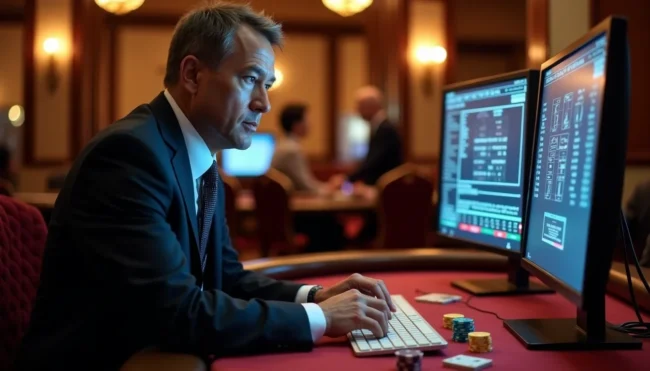
The first time a whale cracks a million-dollar marker in a single night, the host doesn’t flinch. They’ve already run the number three times that afternoon. The suite is comped, the Gulfstream is fueled, and the private chef knows how he takes his steak because the system flagged his reservation at Jean-Georges six months ago in Vegas. The glamour is real enough, the velvet rope, the whispered “Mr. Chen is back,” but none of it moves without a figure attached. That figure is Theo, and Theo is ruthless.
The Number That Runs the Room
Theoretical win sits at the center of every decision made about a high roller. A host looks at a screen and sees not a person but a formula: average bet multiplied by hands per hour, hours played, house edge. A baccarat player putting $100,000 on the bank line each round, grinding through sixty hands an hour, generates roughly $63,600 in theoretical win every sixty minutes. The casino doesn’t need him to lose that night. They need him to keep sitting there, believing his luck is turning, while the edge does its slow work across a hundred sessions.
Average bet gets tracked to the dollar. Time on device or table gets logged automatically through RFID chips and card readers at slots. Game preference shapes the risk profile. Baccarat whales concentrate their damage in narrow windows, slots players bleed more predictably. Frequency and recency of visits feed into predictive models that spit out whether this whale is cooling off or heating up, or whether the competitor down the Strip has a shot at stealing him. Even luck gets quantified. A player whose actual losses consistently undershoot his theoretical losses raises flags. The house starts asking if he’s counting, if he’s connected, or if his luck is the kind that holds.
How They Get Inside the Life
Identification happens before the whale knows he’s been spotted. A pit manager watches a cash buy-in cross six figures without a loyalty card on file. The system auto-flags a theoretical win threshold breached in under an hour. Sometimes another whale brings him through the private entrance, a warm introduction worth more than any marketing campaign. The host materializes before the first shoe ends.
What follows is less service than occupation. The host learns the liquor brand stocked in the suite, the dealer who dealt his first big win, the ex-wife who can’t know about the marker. They log non-gaming appetites, courtside seats for the Lakers, a particular surgeon in case the stress triggers something. Anticipation becomes the product. The jet is arranged before the call comes. The suite is configured from memory. Medical emergencies get handled quietly, with no paperwork or questions. The host becomes indispensable because indispensability is the retention strategy.
Exclusive experiences seal the bond. Private tournaments have no real prize money. Celebrity meet-and-greets happen where the celebrity has been briefed on the guest’s net worth. Access to events that don’t appear on any public calendar reinforces that this relationship transcends transaction, even as every comp is budgeted to a percentage of theoretical loss, typically twenty to forty percent. The whale wins five million in a weekend and still finds his suite upgraded, his dinner comped, because the math is anchored to the long run, not the bad beat.
The Glamour Is the Hook, Not the Product
The velvet rope serves a commercial purpose. A whale walking through a crowded casino floor toward a private salon, flanked by staff, generates aspiration in every player who watches. Some of those aspirational players will never qualify for a host. Enough of them will push harder, stay longer, and chase the status they glimpsed. The whale becomes marketing collateral without knowing it, or perhaps knowing and not caring, because the performance is part of the pleasure.
Competitive markets sharpen the calculation. In Las Vegas and Macau, the quality of invisible service separates properties that hold whales from properties that lose them to a rival offering an identical house edge. The private jet becomes table stakes. The presidential suite with the specific view becomes baseline. Casinos compete on the thickness of the invisible cushion surrounding the play because the play itself is commoditized. Baccarat is baccarat. The edge is the edge. The only variable is whether this whale believes he belongs here more than there.
Living With the Volatility
A single whale on a heater can punch a seven-figure hole in a quarterly earnings report. Casinos absorb this through bankroll management that would make most corporations choke, cash reserves and credit lines sized for catastrophe. Table limits cap exposure even for the biggest players, though exceptions get negotiated in back rooms that most employees will never enter. The real protection is diversification. No property bets its health on three whales when it can court thirty. The law of large numbers only works with large numbers.
Real-time monitoring closes the gap between theory and disaster. Surveillance systems with facial recognition track every high-limit table. Unusual betting patterns trigger immediate alerts. A streak that defies probability long enough gets scrutinized for advantage play, for collusion, or for the kind of luck that isn’t luck. Markers, those lines of casino credit that let whales play without wiring cash, get assessed against verified assets and repayment history. The convenience is real, but the underwriting is tighter than most commercial banks.
The Machine Beneath the Magic
RFID chips in high-denomination stacks let the floor know exactly where money moves without a dealer’s manual input. Player tracking systems from providers like Aristocrat’s Oasis 360 or IGT’s Advantage feed into casino management platforms that merge gaming data with hotel, dining, spa, and retail. A whale’s total resort spend becomes as legible as his baccarat session. Predictive analytics platforms run machine learning across this data to forecast who will become a whale before they know it themselves, optimizing comp offers, identifying defection risk, and calculating volatility down to individual temperament.
The host sees a relationship. The system sees a portfolio. Both are true, and neither works without the other. The whale believes he’s valued for who he is. The casino knows he’s valued for what he generates and manages that value with precision that would impress any quant fund. The contradiction doesn’t resolve. It doesn’t need to. The velvet rope stays up, Theo keeps printing, and the host remembers the steak temperature without ever forgetting what that memory costs and what it earns.